Physiotherapy and Pilates: How to Combine Both After a Muscle Injury
What is the difference between physiotherapy and Pilates?
The simplest way to put it is that physiotherapy is a clinical service and Pilates is a movement method. A physiotherapist assesses your problem, forms a working diagnosis, treats it and adjusts the plan based on how you respond. In Singapore, physiotherapists are registered with the Allied Health Professions Council (AHPC), and the guide to physiotherapy in Singapore explains what to expect from a clinic visit and how to choose one. Pilates is a system of controlled exercise built around breathing, precision and trunk control, first developed by Joseph Pilates and now taught in everything from large group classes to one-to-one sessions on equipment such as the reformer.
That difference matters more than it sounds. A physiotherapist is trained to recognise when thigh pain is actually coming from the lower back, when a “pulled muscle” is really a tendon or joint problem, and when an exercise should be stopped rather than modified. A Pilates instructor, however skilled, is teaching a method rather than managing an injury. Neither is better than the other. They answer different questions, which is exactly why they can work well together.
Singapore now has a large number of boutique reformer studios, and the content of a class can vary widely from one to the next. A general class is designed for a room full of people, not for the specific reason your hamstring or lower back started hurting, so it is worth knowing where you stand before you assume a class will pick up where your rehabilitation left off.
Can you do both after a muscle injury?
Yes, in most cases, but timing matters more than most people expect. Wondering when it is safe to go back to your reformer class after a muscle strain? The honest answer is that it depends on the injury, and it should be decided after an assessment rather than by the calendar.
Current sports medicine guidance on soft tissue injuries, summarised in the PEACE and LOVE framework published in the British Journal of Sports Medicine in 2020, describes two broad phases. In the first few days the priority is to protect the injured area, avoid aggravating it and understand what has happened. After that, the emphasis shifts to load, optimism, blood flow and exercise: gradually adding mechanical stress and returning to normal activities as soon as symptoms allow, using pain as a guide.
In practice, this means physiotherapy on its own is usually the better use of your time and money while the muscle is still irritable. Once you can load the area without a flare, Pilates can become a useful way to keep progressing, because the resistance can be adjusted precisely and the movements are slow and controlled.
In our experience, the patients who run into difficulty are rarely the ones doing too little. More often, they went back to a class a week or two after a strain, found a movement that aggravated it, and could not tell whether the soreness the next day was normal or a genuine setback. Having a physiotherapist alongside your Pilates means someone can answer that question for you.
How Pilates complements physiotherapy treatment
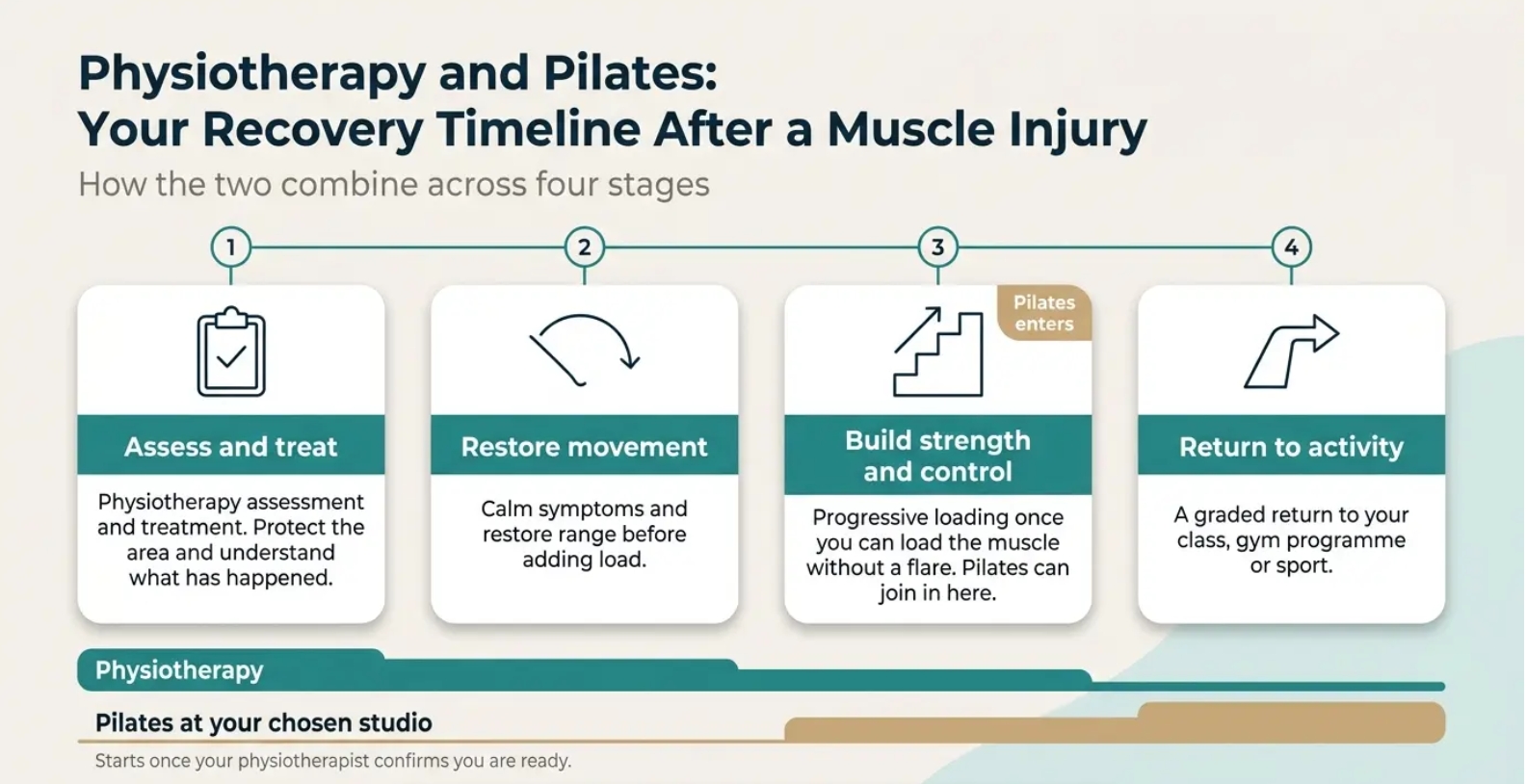
Physiotherapy is strongest at the start of recovery, when the questions are what has been injured, how badly and what to do about it. Pilates earns its place in the middle and later stages, once the question becomes how to rebuild control and stop the problem coming back. Here is how that plays out for the muscle injuries we see most often.
Back muscle strains and recurrent low back pain
Pilates is often promoted for “core strength”, which undersells what it trains. The deep trunk muscles, including the transversus abdominis, the multifidus, the diaphragm and the pelvic floor, work less like a set of muscles to be strengthened and more like a team that controls timing. Pilates suits this well because it asks for control under slow, deliberate load rather than maximum effort.
It is worth being honest about the evidence. A Cochrane review of 10 trials found low to moderate quality evidence that Pilates reduces pain and disability in chronic low back pain compared with minimal intervention, but no clear evidence that it works better than other forms of exercise. The UK’s NICE guideline on low back pain likewise recommends considering group exercise programmes suited to each person’s needs and preferences rather than any single method. What this tells us is that the right progression, and sticking with it, matters more than the brand of exercise. Pilates helps partly because people enjoy it and keep going.
Hamstring, calf and thigh strains
Lower limb muscle strains are common among runners, footballers and weekend gym goers in Singapore. These injuries usually need progressive strengthening of the injured muscle, including work at longer muscle lengths, followed by a graded return to running or sport. That part is best guided by your physiotherapist, because a general class cannot judge when the muscle is ready for speed or impact.
Once that work is underway, reformer exercises can add controlled hip, pelvic and trunk work around it. The same applies to physical therapy exercises for the knee: international consensus on kneecap pain recommends combining hip and knee exercises, and reformer work is one practical way to load the hip in a guided range. The clinical judgement about when you are ready is the physiotherapy part. Some of the loading itself can happily take place on a reformer.
Neck, shoulder and upper back strain from desk work
For Singapore’s desk-based workforce, the most useful thing Pilates offers is not standing up straighter. It is movement variety and mobility through the upper back, which a body that sits for nine hours a day is genuinely short of. Rotation through the mid back, controlled spinal movement and shoulder blade control address the areas that long hours at a laptop tend to stiffen.
One safety point that a clinical assessment will pick up and a general class may not: loaded or repeated forward bending of the spine, as in many classic curling movements, is generally not advised for people with osteoporosis or low bone density because of the risk of spinal fracture.
Who benefits most from combining physiotherapy and Pilates?
The combination suits some situations better than others. It tends to be most useful for:
Back muscle strains and low back pain that settle with treatment but return every few months.
Hamstring, calf and thigh strains in runners and gym goers, once strengthening and a return to running plan are underway.
Desk based workers with neck, shoulder or upper back muscle tension who need movement variety rather than more stretching.
People in the later stages of rehabilitation after surgery, once their surgeon and physiotherapist have cleared them for progressive loading.
Dancers, performers and anyone whose activity demands precision and range rather than raw power.
It is less suited to the first few days after an injury, any pain that has not yet been assessed, and situations where the main concern is medical rather than musculoskeletal. If you have unexplained pain, significant bruising or swelling, pain that is getting worse, or numbness or weakness, get assessed before you book a class rather than after.
